50 Years Later: 50 Things to Know About the Judgment of Paris

  • Wine
  • by WINECOUNTRY COLLECTIVE
  • on APRIL 2, 2026
  • 9891
  • 0
Wine

50 Years Later: 50 Things to Know About the Judgment of Paris

By WineCountry Collective April 2, 2026

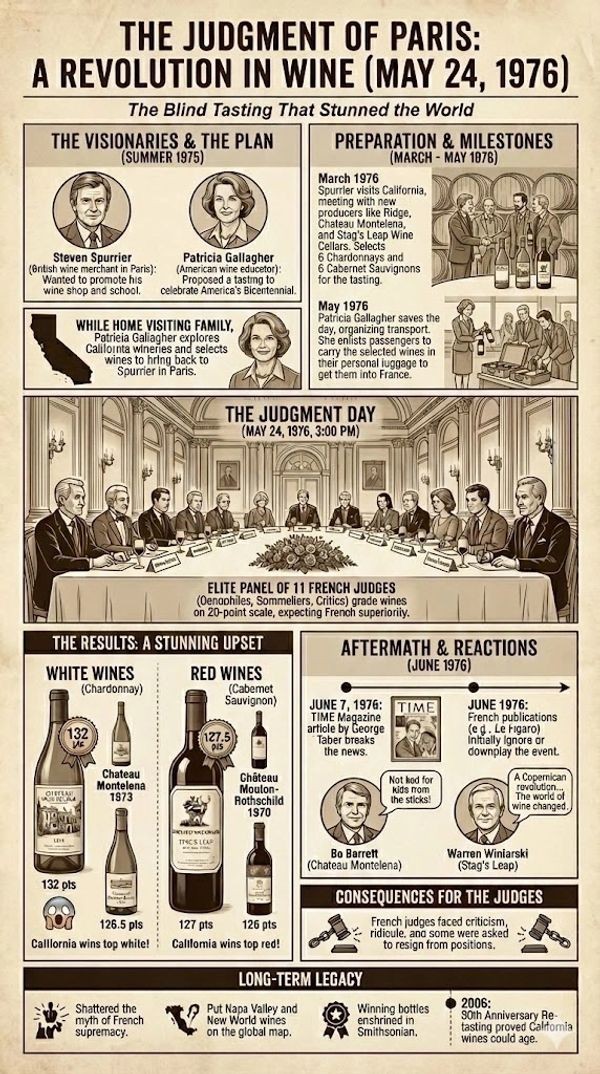
In 1976, a quiet blind tasting in Paris turned into one of the most pivotal moments in wine history. California Chardonnay and Cabernet Sauvignon were placed head-to-head against France’s most revered bottles—with the assumption that the French would, of course, dominate.
They didn’t.
When Napa Valley wines took the top spots in both categories, it sent shockwaves through the global wine establishment, upended centuries of hierarchy, and forever changed how the world viewed “New World” wine. Fifty years later, the ripple effects are still being felt—and celebrated.
To mark the golden anniversary of the Judgment of Paris, here are 50 factual snippets to help you look back at the story, the players, and the lasting legacy of the tasting that changed everything.

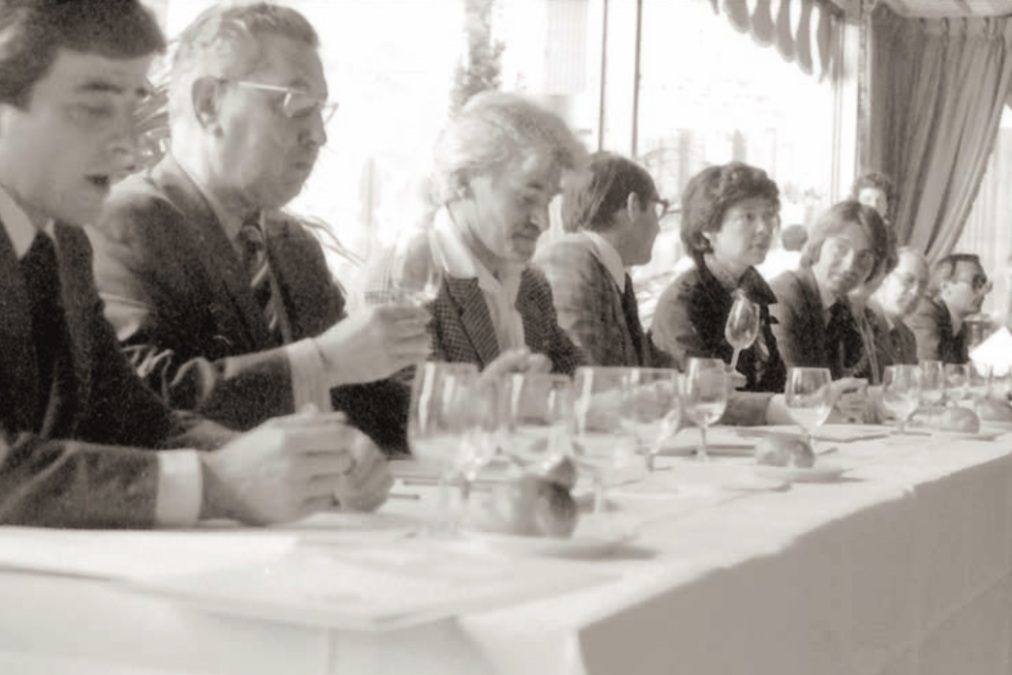
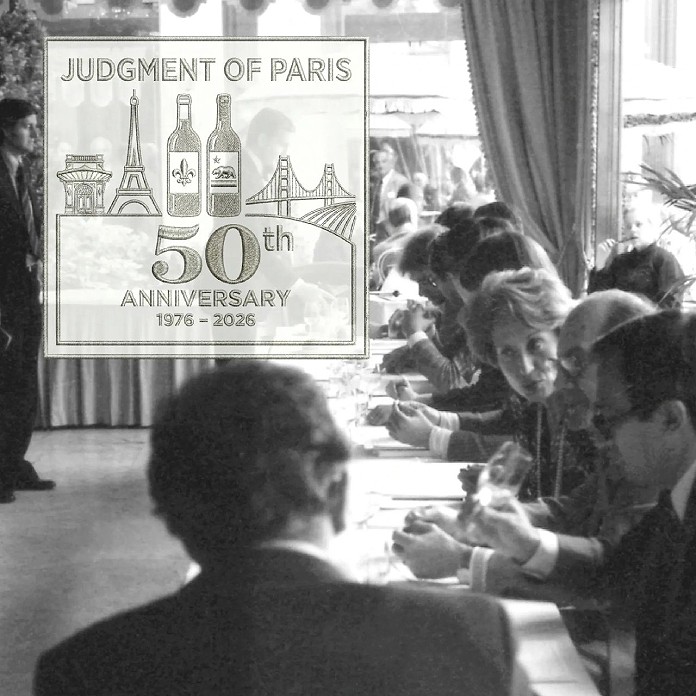
The Judgement of Paris, The Historic 1976 Tasting that Revolutionized Wine
The Judgement of Paris, The Historic 1976 Tasting that Revolutionized Wine, Photo courtesy of The Académie du Vin Library
1. It wasn’t supposed to be a revolution

The tasting was originally intended as a fun, educational comparison—not a showdown. The idea that California wines might actually win was never seriously considered.

2. A British outsider made it happen

Steven Spurrier, a British wine merchant living in Paris, organized the tasting. A champion of French wine, he fully expected France to come out on top.

3. The Académie du Vin set the stage

Spurrier and wine writer Steven Winroth founded the Académie du Vin, a wine school for English-speaking expats, where the idea for the tasting began to take shape.

4. America’s Bicentennial sparked the idea

With the United States celebrating its 200th anniversary in 1976, Spurrier and Patricia Gallagher saw an opportunity to include American wines in a commemorative tasting.

5. California wines were largely unknown in Paris

At the time, even Spurrier had limited exposure to top California producers. Gallagher played a key role in identifying and sourcing wines from Napa Valley.

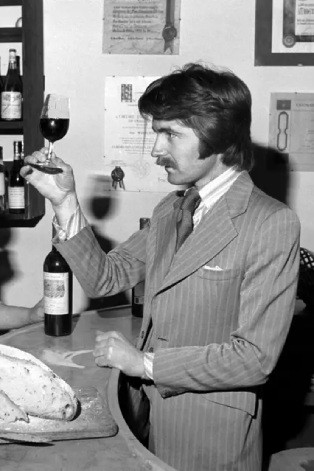
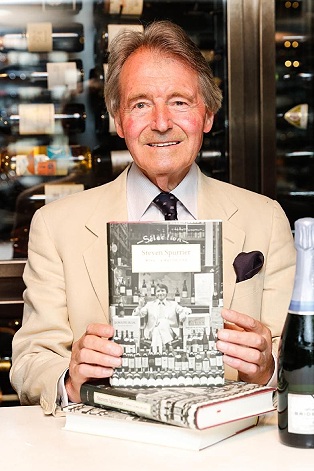
Steven Spurrier
Steven Spurrier, International Wine Legend
Steven Spurrier
Photos courtesy of Forbes Magazine
6. Spurrier personally selected the wines

In early 1976, Spurrier traveled to California and chose six Chardonnays and six Cabernet Sauvignons, without informing wineries they would be entered into a competitive blind tasting.

7. Getting the wines to Paris required improvisation

After purchasing the bottles, Spurrier arranged for them to be transported to Paris via travelers’ luggage, an informal solution for what would become a historic event.

Want to improve your wine knowledge?

From grapes and regions to barrels and glassware, we’re sharing 50 basic wine facts for the budding enthusiast. Learn More

8. The judges were France’s elite

Nine highly respected French judges—winemakers, restaurateurs, and critics—participated in the tasting, lending credibility and weight to the results.

9. It was a true blind tasting

All bottles were concealed, ensuring that judges could not identify origin or producer, allowing the wines to be evaluated solely on quality.

10. Scoring lacked formal structure

Wines were scored on a 20-point scale, but without a standardized rubric, leaving judges to rely on personal criteria and experience.

The Judgement of Paris, The Historic 1976 Tasting that Revolutionized Wine
The Judgement of Paris, Photo courtesy of Judgment of Paris 50th Anniversary
11. The French wines represented the pinnacle of tradition

The lineup included benchmark wines from Burgundy and Bordeaux, including grand cru white Burgundies and classified growth Bordeaux.

12. The California wines were largely from Napa Valley

While Napa dominated the selection, some fruit—such as that used in Château Montelena’s Chardonnay—originated from Sonoma County.

13. The lineup was evenly split

The tasting included 12 wines in total: six Chardonnays and six Cabernet Sauvignons.

Get to Know Napa Valley Cabernet

From its origins to its dazzling character and food-friendliness, we’re breaking down all the facts and figures behind Napa’s king of all grapes. Learn More

14. The French whites came from Burgundy

These included highly regarded wines such as Bâtard-Montrachet and Puligny-Montrachet Les Pucelles.

15. The French reds came from Bordeaux

Notable entries included Château Mouton-Rothschild and Château Haut-Brion.

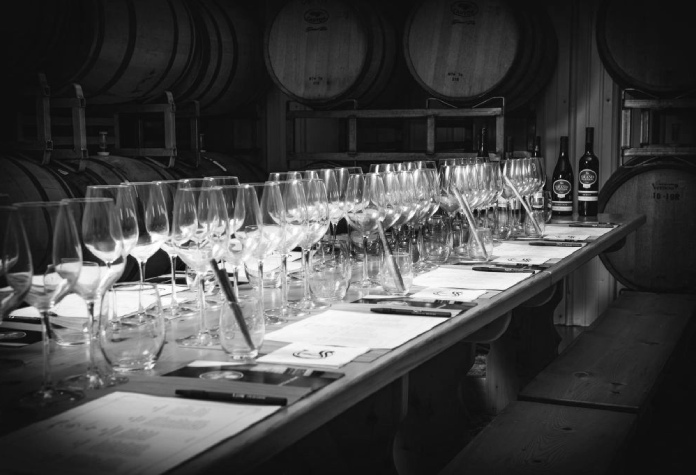
The Judgement of Paris, The Historic 1976 Tasting that Revolutionized Wine
The Judgement of Paris, Photo courtesy of Judgment of Paris 50th Anniversary
16. The California producers were relatively young

Many of the participating wineries had only been established within the previous decade.

17. Some wines were barely released

A few of the California wines had not yet been widely distributed at the time of the tasting.

18. The wineries didn’t know they were competing

Spurrier did not inform producers that their wines would be judged against French counterparts.

19. The tasting was modest in scale

Despite its impact, the event itself was small and relatively informal.

20. No one anticipated the outcome

Even those organizing the tasting expected the French wines to dominate.

21. Judges evaluated wines independently

Each judge scored the wines individually without group discussion influencing their decisions.

22. Some judges misidentified wines

During the tasting, several French judges reportedly assumed certain California wines were French.

23. The results shocked the room

When scores were tallied, the outcome was unexpected for both judges and organizers.

24. California swept both categories

Napa Valley wines ranked first in both the white and red wine tastings.

25. The results challenged long-held assumptions

The tasting disrupted the widely accepted belief that the best wines could only come from Europe.

26. Château Montelena won the white wine category

The 1973 Chardonnay earned the highest score among the white wines.

27. Mike Grgich crafted the winning Chardonnay

Winemaker Miljenko “Mike” Grgich played a key role in the wine’s success.

28. The fruit wasn’t exclusively Napa-grown

Much of the Chardonnay fruit came from Sonoma County vineyards.

29. The winning Chardonnay was affordably priced

At release, the wine retailed for approximately $6.50 per bottle.

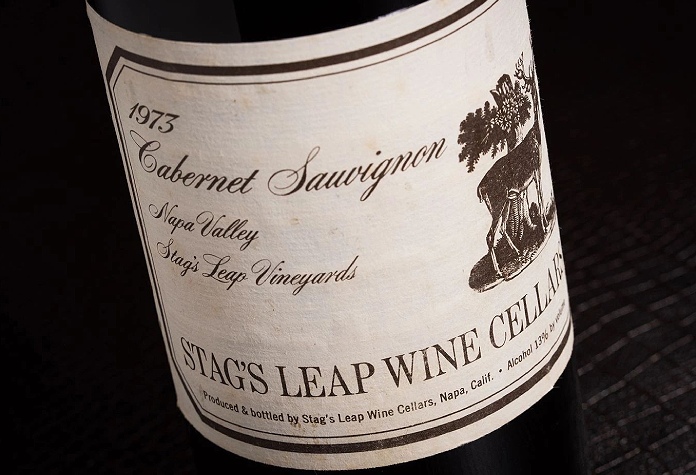
30. Stag’s Leap Wine Cellars won the red wine category

Stag’s Leap Wine Cellars’ 1973 Cabernet Sauvignon achieved the top score among the reds.

Stag’s Leap Wine Cellars’ 1973 Cabernet Sauvignon
Stag’s Leap Wine Cellars’ 1973 Cabernet Sauvignon, Photo courtesy of Judgment of Paris 50th Anniversary
31. Warren Winiarski made the winning Cabernet

He would go on to become one of Napa Valley’s most influential figures.

32. Production was limited

Only about 1,800 cases of the Cabernet Sauvignon were produced.

33. The Cabernet was also modestly priced

It sold for roughly $6 per bottle at release. In case you need a refresher, nowadays the average prices for Napa wines run between $60 – $150+.

34. Both wines became historic benchmarks

Today, they are widely regarded as defining moments in American winemaking.

35. The bottles are preserved in the Smithsonian

Examples of the winning wines are now part of the Smithsonian Institution’s collection.

36. Only one journalist attended

George M. Taber of Time magazine was the sole reporter present.

37. Initial coverage was minimal

Taber’s original article was brief, and the event did not receive immediate global attention.

38. French media dismissed the results

Early reactions in France largely downplayed the significance of the tasting.

39. The story gained recognition over time

As awareness grew, the tasting came to be seen as a defining moment in wine history.

Explore Napa’s Historic Wineries

If you want to fully understand Napa Valley, don’t miss visiting its historic wineries. These are the places that survived Prohibition, won the Judgment of Paris, and helped turn a quiet farming region into one of the most famous wine destinations in the world. Explore Now

40. Taber later documented the event in detail

His 2005 book, Judgment of Paris, helped solidify its legacy.

41. The tasting elevated California wine globally

International demand for California wines increased significantly following the event.

42. Napa Valley experienced rapid growth

The number of wineries expanded from roughly 60–70 in the 1970s to more than 500 today.

Napa’s Most Beautiful Wineries

It’s true, before the Judgment of Paris, Napa Valley was home to under 70 wineries. Today, that number has grown to more than 500. We’ve somehow narrowed down a list of the ten most picturesque. See The List

43. The winemakers became influential figures

Both Mike Grgich and Warren Winiarski went on to shape the future of Napa Valley.

44. Skeptics questioned the wines’ longevity

Some critics initially believed the California wines would not age well.

45. Anniversary tastings proved otherwise

Re-tastings in 1986 and 2006 demonstrated the aging potential of the wines.

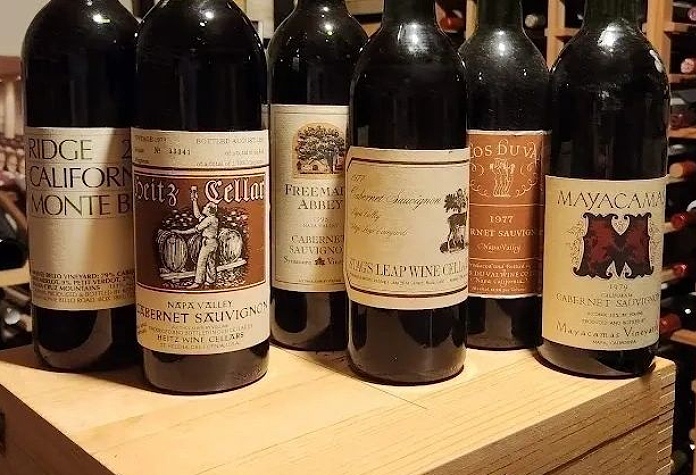
Judgment of Paris Wine Selection 2026
Judgment of Paris Wine Tasting Selection 2026, Photo courtesy of Judgment of Paris 50th Anniversary
46. Ridge Monte Bello rose to the top in 2006

The 1971 Monte Bello Cabernet Sauvignon ranked first in the 30th anniversary re-tasting.

47. The event influenced modern tasting practices

Blind tasting became more widely accepted as a standard for fair evaluation.

48. It reshaped perceptions of terroir

The results broadened understanding of where world-class wine could be produced.

49. The story reached popular culture

The 2008 film Bottle Shock brought the event to a wider audience.

50. It changed the global wine narrative

The Judgment of Paris ultimately proved that exceptional wine is not defined by geography alone.

Final Pour

Fifty years later, the Judgment of Paris still feels like a plot twist no one could have written—except it actually happened. And in doing so, it gave the wine world something far more interesting than certainty: possibility. Cheers to its 50th anniversary!